




Most people think they know what flirting is, until they're in a situation where it matters. A colleague keeps complimenting you. A friend texts a little too often. Your partner hasn't flirted with you in months. Suddenly the definition feels a lot less obvious. This article unpacks what flirting actually means, how to recognize it, and why keeping it alive in your relationship is one of the most underrated things you can do.
- 🔍 The Definition of Flirting
- 👥 Flirting vs. Just Being Friendly
- ✨ Signs Someone Is Flirting With You
- 🎯 Why Flirting Is a Skill, Not Just an Instinct
- 💑 What Flirting Looks Like in a Long-Term Relationship
- ⚖️ The Boundary Question: When Does Flirting Become a Problem?
- ❓ Questions to Explore Together About Flirting and Attraction
The Definition of Flirting (And Why It's Blurrier Than You Think)
At its core, flirting is a form of social interaction where one person signals romantic or sexual interest in another, usually in a way that leaves some room for deniability. The Wikipedia definition puts it well: flirting is when someone obliquely indicates romantic or sexual interest through conversation, body language, or light physical contact, one-sided or mutual.
But what makes flirting genuinely hard to define is that plausible deniability piece. As one Reddit user summed it up: "For flirting you need plausible deniability. If it goes wrong, you can brush it off as not flirting. If it goes right, you can say you successfully flirted."
That gray zone is exactly why flirting causes so much confusion. Is it a long look that lasts a second too long? A compliment delivered with a particular tone? A conversation that feels charged but technically says nothing explicit? The answer is: often all of those things, and more. The intent behind the behavior is what turns ordinary friendliness into flirting.
But what makes flirting genuinely hard to define is that plausible deniability piece. As one Reddit user summed it up: "For flirting you need plausible deniability. If it goes wrong, you can brush it off as not flirting. If it goes right, you can say you successfully flirted."
That gray zone is exactly why flirting causes so much confusion. Is it a long look that lasts a second too long? A compliment delivered with a particular tone? A conversation that feels charged but technically says nothing explicit? The answer is: often all of those things, and more. The intent behind the behavior is what turns ordinary friendliness into flirting.
Flirting vs. Just Being Friendly: How to Tell the Difference
This is the question that keeps people up at night. The honest answer is that context and consistency are everything.
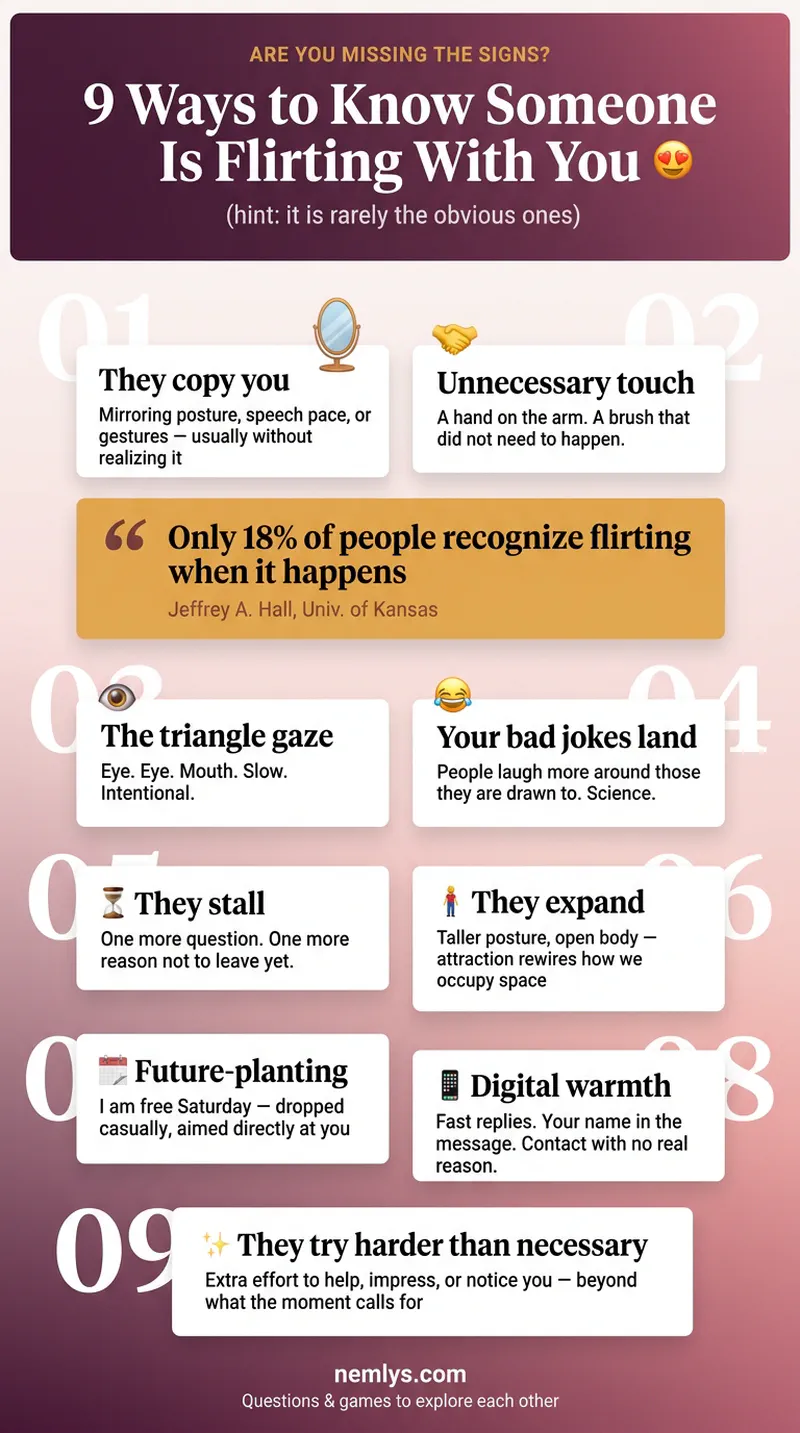
Friendly people treat most people the same way. Someone who is flirting changes their behavior around the person they are interested in: they are more attentive, more playful, more physically present. Research by Jeffrey A. Hall at the University of Kansas found that only 18% of women accurately identified when someone was flirting with them, partly because the signals are subtle and easily confused with ordinary warmth.
A few patterns that tend to separate flirting from friendliness:
Friendly people treat most people the same way. Someone who is flirting changes their behavior around the person they are interested in: they are more attentive, more playful, more physically present. Research by Jeffrey A. Hall at the University of Kansas found that only 18% of women accurately identified when someone was flirting with them, partly because the signals are subtle and easily confused with ordinary warmth.
A few patterns that tend to separate flirting from friendliness:
- They ask personal questions, not just polite ones. "How's your day?" is friendly. "What do you actually want out of life?" aimed specifically at you, with real interest, leans closer to flirting.
- They find reasons to be near you. Physically moving closer, finding excuses to continue a conversation, lingering after a natural stopping point.
- Compliments are specific and personal. "Nice jacket" is casual. "The way you explained that earlier was really impressive" is more loaded.
- There is eye contact that stays a beat longer than usual. It is hard to quantify, but most people feel the difference.
- Teasing with a soft landing. Playful teasing that is slightly affectionate, not neutral banter.
- Their phone comes out less. When someone is interested in you, you tend to have their full attention in a way that feels distinct from ordinary conversation.
- They remember small things you mentioned. Circling back to something specific you said before is a quiet signal of real attention.
- Their behavior is different with you than with others in the group. The clearest sign: if you're being treated notably differently, that difference means something.
Signs Someone Is Flirting With You (Even When It Feels Ambiguous)
Beyond the general patterns, there are more specific signals worth knowing. None of these are definitive on their own. Taken together, they start to paint a clearer picture. Interestingly, observational research by Karl Grammer and T. Joel Wade on real courtship behavior found that men who successfully initiated contact with women showed distinct body language beforehand: more glancing, more space-maximizing movements (standing taller, taking up more room), and more open postures. Attraction changes how people physically occupy space, often before a single word is spoken.
- Mirroring your body language. When someone unconsciously copies your posture, gestures, or speech patterns, it usually signals interest and rapport.
- Touching that isn't strictly necessary. A hand on the arm during a conversation, a touch on the shoulder when they pass, a slight brush that didn't need to happen.
- The "triangle gaze." Looking from one eye to the other and then down to the mouth is a documented pattern associated with romantic interest.
- Laughing at things that aren't that funny. We laugh more around people we are attracted to. If someone finds your mediocre jokes consistently hilarious, pay attention.
- Looking for reasons to extend the interaction. Another question right when the conversation should have ended. Suggesting a follow-up before you've even finished the current exchange.
- Being self-conscious around you. Straightening up, adjusting their appearance, seeming slightly nervous or heightened. Attraction activates a kind of awareness people don't have with friends.
- Bringing up availability or plans. Mentioning they are free this weekend, asking what you are doing, or casually including a future scenario with you in it.
- Digital signals. Responding quickly, using your name, sending something specifically relevant to a prior conversation, or initiating contact for no particular reason.
- Giving more than the interaction requires. Going out of their way to help, to compliment, to notice. Extra effort beyond what the social situation calls for.
Why Flirting Is a Skill, Not Just an Instinct
Most writing about flirting treats it as something you either notice or don't, something that happens to you. But flirting is also something you do, and it is something you can get better at.
For some people it comes naturally. For others, it feels awkward or forced. The difference is rarely about charisma. It is mostly about comfort with ambiguity and willingness to show a little vulnerability without a guaranteed response.
The good news: flirting does not require being slick. The most effective flirting tends to be genuine. A real compliment. Actual curiosity about the other person. A little more eye contact than usual. Showing that you find someone specifically interesting, not just generically pleasant.
This is also why flirting gets harder in long-term relationships, not because attraction fades, but because the plausible deniability disappears. When you've been with someone for years, you already know how they feel about you. There is less ambiguity, less novelty, less reason to try. Which is exactly why making the effort anyway tends to mean so much.
For some people it comes naturally. For others, it feels awkward or forced. The difference is rarely about charisma. It is mostly about comfort with ambiguity and willingness to show a little vulnerability without a guaranteed response.
The good news: flirting does not require being slick. The most effective flirting tends to be genuine. A real compliment. Actual curiosity about the other person. A little more eye contact than usual. Showing that you find someone specifically interesting, not just generically pleasant.
This is also why flirting gets harder in long-term relationships, not because attraction fades, but because the plausible deniability disappears. When you've been with someone for years, you already know how they feel about you. There is less ambiguity, less novelty, less reason to try. Which is exactly why making the effort anyway tends to mean so much.
Struggling to find ways to flirt with or reconnect with your partner? Nemlys has conversation starters and questions designed specifically to bring back playfulness and spark, whether you're a new couple or have been together for years. Free to try.
Try Nemlys freeWhat Flirting Looks Like in a Long-Term Relationship
Here is the thing most relationship content misses: flirting is not just for the early stages. In fact, research consistently shows that couples who continue to flirt with each other report higher relationship satisfaction. But the form it takes changes over time.
Early-stage flirting is about signaling interest and building tension. Long-term flirting is about maintaining them. It's a reminder: I still notice you. I'm still interested. You still do something to me.
What it looks like in practice:
Early-stage flirting is about signaling interest and building tension. Long-term flirting is about maintaining them. It's a reminder: I still notice you. I'm still interested. You still do something to me.
What it looks like in practice:
- A compliment delivered as a genuine observation, not a routine. Noticing something specific about how your partner looks or acted today, not just a habitual "you look nice."
- A text that has no purpose except to say you were thinking about them. No logistics. No question that needs answering. Just a small signal of presence.
- Physical contact that is slightly deliberate. A touch that lingers a second longer than functional. A look that says more than the words do.
- Inside jokes and shared references. Playful callbacks to things only the two of you know. This is a form of intimacy that feels distinctly like flirting because it excludes everyone else.
- Showing genuine curiosity about them. Asking a real question about what they are thinking or feeling, with actual interest in the answer. Not "how was your day" but something more specific and alive. If you're stuck, playful, flirty questions are a surprisingly easy way to restart that dynamic.
- Doing something that requires a little vulnerability. Writing a note. Planning something specific to their taste. Saying something that exposes how much you care. Risk is part of what makes flirting feel like flirting.
- Catching their eye across a room. Simple. Small. Disproportionately powerful.
- Being a little playfully difficult. Light teasing, a raised eyebrow, a fake-skeptical response to something they said. Playfulness that signals you see them and find them interesting.
The Boundary Question: When Does Flirting Become a Problem?
This is the real reason many people end up searching for a definition of flirting. Not because they are curious philosophically, but because something specific is making them uncomfortable, and they want a clearer sense of where the line is.
There is no universal line. Every relationship has its own agreements, and what feels fine in one couple's context might feel genuinely problematic in another's. But some general patterns tend to hold:
If you are uncertain about where a line is, that uncertainty itself is often worth a conversation with your partner. Not an accusation or a confrontation, but a real exchange about what flirting means to each of you and what you both want.
There is no universal line. Every relationship has its own agreements, and what feels fine in one couple's context might feel genuinely problematic in another's. But some general patterns tend to hold:
- Flirting that would change if a partner were present is worth examining. If you would behave differently in front of your partner, that's information about what the behavior means to you.
- Frequency and exclusivity matter. Casual flirtatious warmth is one thing. Ongoing, exclusive, escalating attention directed at a specific person is something else.
- What the other person thinks counts too. As one Reddit commenter put it plainly: "If the other person thinks you are flirting, then you are flirting." Their experience of the interaction is part of what defines it.
- Emotional intimacy that is kept private from a partner. Flirting that tips into confiding, into being each other's go-to emotional support in ways that are hidden, tends to cross into territory that most couples would identify as a problem.
- The question to ask yourself: Does this make me feel closer to my partner, or does it take something from that relationship? Honest answers to that question tend to clarify more than any external definition.
If you are uncertain about where a line is, that uncertainty itself is often worth a conversation with your partner. Not an accusation or a confrontation, but a real exchange about what flirting means to each of you and what you both want.
Questions to Explore Together About Flirting and Attraction
Some of the most valuable conversations couples can have are the ones they have never quite had. These questions are a good place to start:
- What does flirting mean to you? What counts and what doesn't?
- Do you feel like we still flirt with each other? What would more of that look like?
- Is there something I used to do early in our relationship that you miss?
- What does it feel like when I notice you, as opposed to just being around you?
- Are there things I do with other people that you would want me to do only with you?
- What is one thing you find genuinely attractive about me right now, today?
- When do you feel most desired by me?
- What's something small I could do more of that would make you feel wanted?
- Do you think we have clear enough agreements about what is okay with other people? Is there anything you have been uncertain about?
- What is your favorite memory of us flirting, early on or recently?
These questions (and hundreds more) are inside Nemlys, a free app for couples with conversation starters, games, and topics designed to keep you genuinely close, whatever stage you're at.
Explore Nemlys